Tuesday, 20 February 2018

The all-out assault on your money


I came across this worrying interview about the disappearance of cash from the Swedish economy. The same thing is happening in Australia where Tap-And-Go is rapidly replacing cash transactions in our small business. We have seen cash purchases go from 75% of our takings to less than 25% within 2 years. This is driven by 'convenience' but is being pushed from all sides - banks, governments, technology and telcos. Bank branches are closing, ATMs are disappearing. 
This is an assault on the ownership of cash. Instead, banks are renting our money to us. We are losing our liberty of transaction with everything intermediated by a broker. Once we no longer own our money, our centralised banking system can do perverse things to us - negative interest rates are just the start. At the flick of a switch, our access to our money can be turned off - don't think this could happen in a developed country? Just ask Greece.
I expect that the RBA plans to scrap the $100 note during the current round of bank bill replacement. 
You need to stand up for our right to own our own money! 

Australian Retail Association slandering cash - http://www.bpaybanter.com.au/news-views/melbourne-butcher-refuses-cash
ATO cracking down on cash - http://www.smh.com.au/business/the-economy/ato-cracking-down-on-cash-economy-20140825-1082c9.html
VISA bribing businesses to stop accepting cash - http://money.cnn.com/2017/07/14/news/companies/visa-no-cash-restaurant-initiative/index.html

Tuesday, 17 October 2017

Discussions on Melbourne weather radars

On the evening of 12 Oct 2017, I went to bed as normal but noticed I didn't feel comfortable in bed. My heart was racing and I got a sense of discomfort every few seconds. Eventually I got up and moved to the spare bedroom on the other side of the house and was able to sleep.
A few weeks ago, the regular Melbourne metropolitan weather radar at Laverton was taken offline and the training system at Broadmeadows was made 'live' to cover the period while the Laverton station was upgraded.
From my location in the Dandenongs, Broadmeadows is 10kms closer than Laverton (40 kms vs 52 kms). The line-of-sight angle to Broadmeadows is also different, directed more towards me at sleep while the Laverton site is somewhat shielded by a brick wall.

Map showing location of weather radars and attitude to my house:


So the question arises - is my discomfort caused by the weather radars, and is it worse because of the passing storm?

Weather radar images of the storm passing through:
Radar image loop: 128km Radar Loop for Melbourne AP, 00:00 11/10/2017 to 00:00 12/10/2017 UTC

My thoughts

  • The primary radar site covering the Melbourne metropolitan area is closer to my house and is more directly in line-of-sight as I sleep.
  • Is the replacement radar system the same as the previous one or are there differences in the radiation profile, radiation strength?
  • Was the replacement radar 'usually' working prior to the primary site being taken offline?
  • We live on top of a hill, so a radar looking for rain activity will be directed upwards, potentially directly to where I live.
  • Is it possible that a weather radar adapts it's signal profile if a rain event is passing through the area, potentially increasing signal strength to penetrate rain clouds better?
To try to get some answers, I put some questions in to the Bureau of Meteorology and was very pleased to get answers from Andrew Collins, Head of Radar. Here are the emails.

Terminology

C-band = microwave radiation, 4.0 - 8.0 GHz link
S-band = microwave radiation, 2-4 GHz link 
Magnetron = a high powered microwave generator link
Klystron = a high powered microwave generator link
Dual polarisation = a microwave signal containing both horizontally and vertically polarised beams link
PRF = Pulse repetition frequency link

From Richard Cullen to BOM media relations

Hi Sally
Thanks for taking my call earlier. 
I am interested to know some more about the weather radars that are active in the Melbourne area. I understand that the Laverton centre is being upgraded and that the Broadmeadows centre is the primary site at the moment. I found this 'explainer' video on Youtube https://www.youtube.com/watch?v=YeLRr56K7UA so perhaps Steven McGibbony is the right person to be in touch with?

My questions are of a technical nature about the radar systems that are active and which are being deployed, in particular some more in-depth information regarding the radar signals being generated by each centre and the radio-frequency emissions. 
Specific questions include:
- what are the makes and models of the radar units? Are there specification sheets that can be provided?
- what are the power ratings of each unit, and under what conditions would power emissions be increased?
- what are the rates of rotation of each unit?

Many thanks
- Dr Richard Cullen

From Andrew Collins to Richard Cullen (12 October 2017)

Hi Richard,
 
The Bureau uses several types of radars. We operate both C-band and S-band.  Magnetron transmitters at 250kW (C-band) and 850kW (S-band) and 750kW klystrons (Meteor 1700S radars).
 
Our scan rates vary as we generally do 14 elevations over a 6-minute or 10-minute scan strategy.
 
Buckland Park (Adelaide) for example - Long Range Scan: Single elevation angle (0.5º) at 400 Hz PRF. Maximum range of 375 km for extension of reflectivity products. Dual Polarisation mode: 14 elevation angle scans, 1000 Hz PRF, second-trip recovery. Maximum range up to 300 km, restricted to a maximum observed altitude of 20 km (i.e. maximum range decreases with increasing elevation angle).
Elevation angles scanned: 0.5º, 0.9º, 1.3º, 1.8º, 2.4º, 3.1º, 4.2º, 5.6º, 7.4º, 10.0º, 13.3º, 17.9º, 23.9º, 32.0º.
 
The hyperlinks below are our two current radar OEM with basic commercially available specifications.
 
http://www.eecweathertech.com/pdf/EEC-C-Band-Systems.pdf
 
http://www.de.selex-es.com/documents/16243296/30914095/Selex-ES-METEOR-1700S.pdf
 
If you need any other information please contact me directly.
 
Regards,
 
Andrew
 
Andrew Collins | Head of Radar

From Richard to Andrew (13 Oct 2017)

Thank you for getting back to me so promptly, Andrew. I very much appreciate the information.
My interest is particularly in the RF emissions from the radars deployed within the Melbourne area and in particular how the changes in the active sites and upgrades to existing sites (Laverton) can be expected to change the profile. 
Specifically, the Laverton site was removed from operation and the Broadmeadows site made primary as the Laverton site gets upgraded. Were Laverton and Broadmeadows running the same systems or are their any differences? Can you share any information about the old-vs-new equipment being deployed into Laverton?
I also have a question regarding the operation of weather radars, particularly as storms come through. The challenge for a weather radar system is achieving range during storm activity, as the water in the clouds and rain absorb the signal. Therefore does the system adapt the strength of the transmission signal dependent on the conditions? i.e. if an accurate signal for distant locations can't be obtained due to clouds closer by, does the system increase transmission levels to compensate? And conversely, if conditions are favourable, does the system decrease transmission strength?

Many thanks

From Andrew to Richard (16 Oct 2017)

Hi Richard,
 
Broadmeadows radar is a C-band (5607MHz) 250kW magnetron running at 1000Hz PRF with a 1µS pulse.
 
Laverton radar is a S-band (2880MHz) 750kW klystron running at 1000Hz PRF with a 1µS pulse. Please bear in mind as this radar has recently undergone dual-polarisation upgrade, it will emit 375kW out of the vertical and horizontal channels respectively. Therefore, EIRP is reduced by 3dB. This is the only recent change. Whilst you may of never saw Broadmeadows on the web before it has been alive and kicking in a training role. It was made live to cover for the Laverton upgrade.
 
No, the output power remains constant in all conditions, obviously receiver gain varies with range. S-band have much better penetration and less rain attenuation than C-band but a little reduction in resolution.
 
 
Regards,
 
Andrew

From Richard to Andrew (16 Oct 2017

Thank you for the detailed update, Andrew.

>> it will emit 375kW out of the vertical and horizontal channels respectively
I presume simultaneously rather than in 2 separate passes?

Thanks

- Richard

From Andrew to Richard (17 Oct 2017)

That is correct, simultaneously.
 
Regards,
 
Andrew

Wednesday, 13 September 2017

ACMA 5G "Spectrum for broadband in mmWave bands" consultation submission

In September 2017, ACMA announced a consultation process regarding consideration of using mmWave frequencies for mobile broadband applications in Australia. Specifically this means 5G technologies at 26GHz, with other frequencies to be considered. This is part of fast-tracking the spectrum auction and accelerating 5G roll-out across Australia.

The document listing the Questions for Comment and the submission upload form are here: https://www.acma.gov.au/theACMA/spectrum-for-broadband-in-mmwave-bands

I'll be developing my submission here:
https://docs.google.com/document/d/1MMRpZCNUKqMs2DAWFt7n3proVXzsmEQqbD9SFb8qSTw/edit?usp=sharing


Tuesday, 12 September 2017

Auction plan for 5G spectrum being expedited

To: Federal Minister and Shadow Minister for Communication, Federal Minister and Shadow Minister for Health, James Merlino MP, Jason Woods MP, Editor - The Age

Sirs,
I contact you today to raise my concerns that the commercial drum-beat to auction off the 5G spectrum is being fast-tracked without adequate safety standards having been established.
The matter of the auction of 5G spectrum being expedited was covered in today's edition of The Age: http://www.theage.com.au/business/media-and-marketing/australian-regulator-fasttracking-upcoming-5g-auction-at-superhigh-frequency-20170911-gyewu4.html

This is clearly a case where commercial interests and the dangling carrot of billions of dollars in spectrum revenue are combining to over-rule any concerns regarding adequate protection of public safety. 

The properties of 5G radiation of 5GHz and above are totally different to that of 3G/4G and previous iterations of mobile technologies. Due to their higher frequencies, 5G waves cannot penetrate solid objects including human bodies, resulting in maximum absorption in the outer skin layers, eyes, ears etc. These organs are not inert, containing for instance T-cells which form a primary component of our immune system. 

The international technical committee which oversees the testing methodologies for microwave radiation - IEC  technical committee TC 106 - has not even established a process to start defining safety measurement protocols for 5G radiation, let alone feed into the ICNIRP/ARPANSA process to establish safety exposure limits. ICNIRP does not consider 'biological' impact when setting safety limits, only thermal effects and considers skin to be a 'secondary organ' despite it's key role in blocking 5G radiation. ICNIRP is demonstrably corrupted by corporate vested interests.

5G mobile technology roll-out needs to be brought in check to avoid a health and well-being catastrophe for this state and our nation, brought about by the greed of government revenue-raising and corporate vested interests. I look forward to hearing from you on these matters.

Regards
- Dr Richard Cullen
Sassafras, Victoria

I refer you to a blog post I wrote in November last year, having witnessed the debacle at the annual 'Wireless and Science' event at RMIT, noteable for the cavalier disregard for actual scientific process.

I also refer you to this presentation presented last month in Brisbane detailing the current state of the science and technology. https://betweenrockandhardplace.wordpress.com/2017/09/05/full-video-of-leszczynski-lecturing-at-the-griffith-university-in-brisbane-australia/

Wednesday, 23 November 2016

How NBN will drive autoimmune diseases across Australia

The NBN will be responsible for driving autoimmune diseases in Australia. 

How? NBN threatens Telstra directly as they'll be unable to differentiate ISP services based on network reach. So for them, establishing and maintain a superior mobile network - one that can deliver faster-than-NBN data - is an existential issue. They'll drive 5G adoption harder than any other Telco on the planet - the others don't have to contend with a level NBN playing field. Mike Wood from Telstra is chairing the technical committee defining radiation safety limits over the 5G spectrum [link to IEC TC106 page] - that's not coincidental.
The frequencies used by 5G are higher than existing mobile RF and will be absorbed primarily by the skin [see below]. The skin hosts immunological cells, forming a primary immune defence system. Persistent and aggressive activation of dermal T-cells and T-cell activation can lead to an autoimmune response
TL;DR - expect to see a rise in autoimmune conditions like Rheumatoid Arthritis, Lupus, Hashimotos, Irritable Bowel Syndrome etc etc.
ICNIRP admits that their guidelines do not currently account for the radiation safety issues surrounding higher frequency RF and they expect to classify 'skin' as peripheral along with arms and legs despite skin being an immunological organ and being the primary absorbent matter for +6GHz radiation. The measurement procedures for the evaluation of power density related to human exposure between 6GHz and 100GHz have not been developed [link to IEC 'call for experts' Nov2016]. 
So without effective health safety guidelines, no health safety research or testing and no effective regulations, industry will drive forth and start the rollout of this new technology within the next 5 years. Given the inability to differentiate on fixed broadband, Telstra especially will be at the forefront. The gates are open and the horse is bolting.

Key take-aways

  • Telstra are leading the international committee defining the radiation exposure levels for 5G standards.
  • The absorption profile for 5G radiation is completely different to existing mobile phone radiation.
  • Work has not even started on defining the safety standards for 5G radiation.
  • ICNIRP is only concerned with thermal effects of RF radiation. In the case of 5G, this will be skin warming only.
  • ARPANSA radiation limit standards are based on ICNIRP guidelines.
  • T-cells (part of the human immunological system) in the skin react to microwave radiation in the 5G spectrum.
  • Immune system provocation can lead to development of autoimmune diseases.

Supporting evidence

  • 5G spectrum allocation above 6GHz (source: http://telecoms.com/opinion/5g-is-this-the-technology-that-will-deliver-the-ultimate-mobile-experience/, original source: Nokia)
  • Absorption of microwave radiation above 6GHz is primarily within the skin rather than the body: " For frequencies greater than 3 GHz, the MPE is expressed in terms of the incident power density"Source: "C95.1-2005 - IEEE Standard for Safety Levels with Respect to Human Exposure to Radio Frequency Electromagnetic Fields, 3 kHz to 300 GHz", pages 25-26. [link]
  • Microwave attenuation in tissue by frequency (source: http://www.intechopen.com/books/ultra-wideband-radio-technologies-for-communications-localization-and-sensor-applications/ultramedis-ultra-wideband-sensing-in-medicine)

  • IEC 'call for experts' November 2016
    http://www.iec.ch/dyn/www/f?p=103:30:28935567148492::::FSP_ORG_ID,FSP_LANG_ID:1303,25

"Science and Wireless 2016" - my thoughts.

"Science and Wireless 2016" - my thoughts. 

Or... "And you wonder why is the public losing faith in science?"

On November 22nd, the Australian Centre for Electromagnetic Bioeffects Research (ACEBR) held the 10th annual "Science and Wireless" meeting. 4 papers were presented.
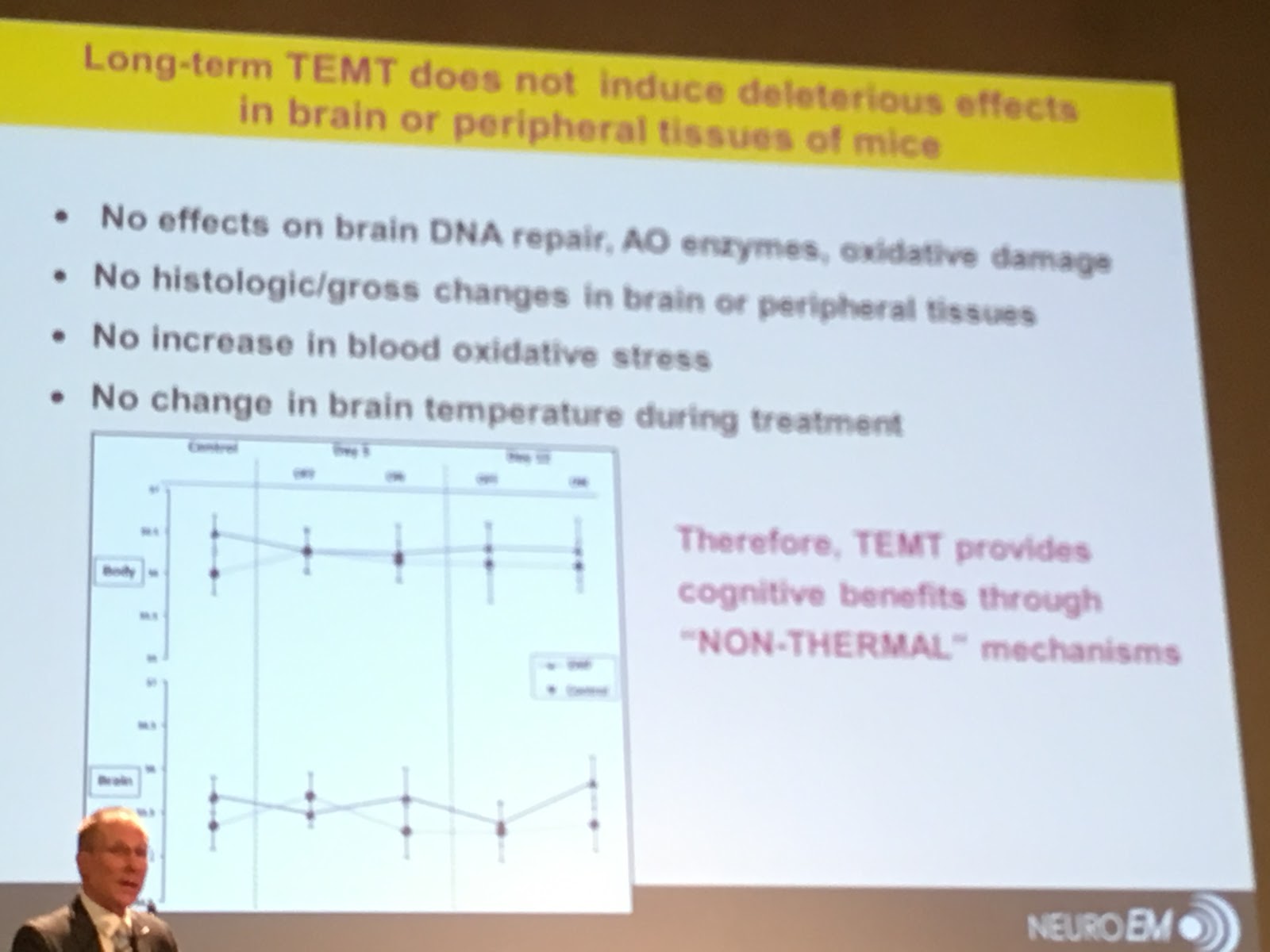
Papers 1 (Keynote: "Transcranial Electromagnetic Treatment (TEMT) against Alzheimer's Disease: Pre-Clinical Efficacy and Clinical Trial in Progress", Dr Gary W Arendash) and 2 ("ACEBR research on RF effects on Alzheimer's disease", Prof John Finnie) were reviewing exciting new developments in using 900MHz RF-EMF to treat Alzheimer's Disease. The results look very promising as a therapy to reverse the build-up of Beta-amyloid plaques in neurons in Alzheimer patients. There are 3 suggested mechanisms of action - (1) Disaggregation of beta-amyloid plaques (RF breaks protein bonds), (2) enhanced mitochondrial function and (3) increased neuronal activity. The pre-clinical results are very promising. This is a very exciting development because drug-based therapies for this disease have proved ineffective thus far. If I had Alzheimer's, I would be first in line.
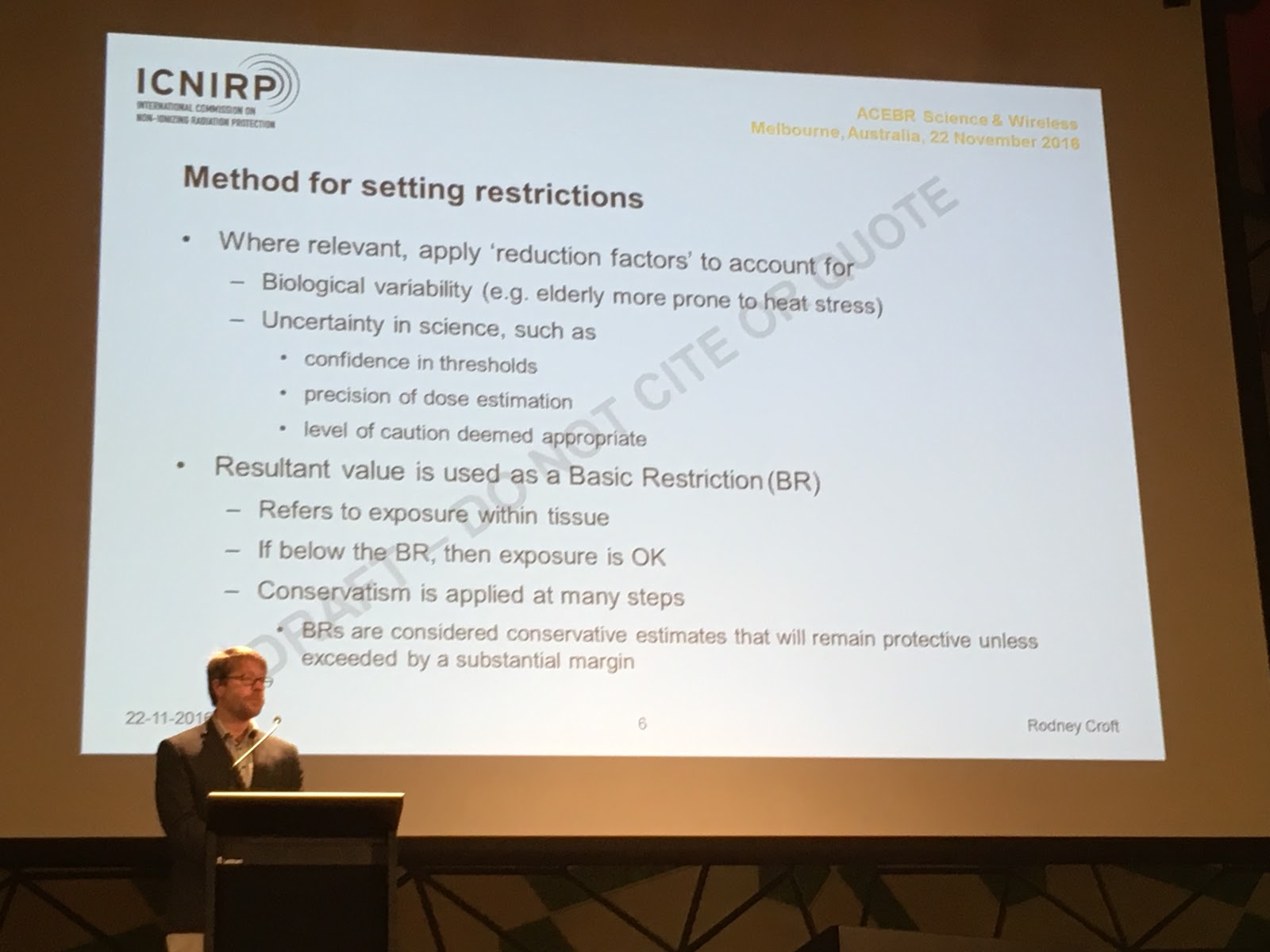
Paper 3 ("ICNIRP High frequency guidelines - an update", Prof Rodney Croft) described work-in-progress to update the ICNIRP guidelines. Sorry I didn't capture all of the slides. Long story short - they consider health effects, not biological effects, and when health effects can't be measured they're using thermal effects as a proxy for quantifiable measurement. Absorption rates are split between 'head and body' and 'limbs' (which includes skin). They're going to be setting guidelines for 6+GHz based on power density rather than SAR, but looks like it's averaged over an area rather than point exposure.
Paper 4 ("5G devices and networks: exposure standards", Mike Wood, Telstra) by Mike Wood of Telstra and chairman of the international consortium developing 5G technologies. SAR will not be used for measuring exposure of 5G radiation due to the limited ability of 10+GHz radiation to penetrate the body; incident radiation power will be used instead. 5G radiation is absorbed primarily in the skin. No safety testing methodologies currently exist. Various device radiation measurements techniques are being developed to scan a detector across the device, but then the radiation is averaged over the entire device. No control of point-based radiation levels. Base stations will use phased arrays and beam-forming techniques to better direct the signal to the active device. This will provide a better connection and higher data rates while reducing the ambient radiation levels, but watch out if you're in line with an active connection. Systems should be available for commercial roll-out in 2020.

Other notes

During his presentation, Arendash dismissed the plausibility that cell phones could cause cancer because the energy levels could not cause ionisation. During the Q&A, a member of the audience pointed out that RF-EMF has been demonstrated to cause Reactive Oxygen Species (ROS) and that they are known carcinogens [first google result]. 
Another member of the audience asked why the modulation frequencies are not being considered, just the carrier frequencies, and that the modulation frequencies are just as important. Wood claimed that there are no new modulation techniques in 5G, however he didn't say there were no new modulation frequencies. No-one discussed whether pulsing vs constant exposure is important.
Another audience member pointed out the rapid rise in chronic diseases - cancer, autism, neurodegenerative diseases etc. The panel did not have much to say in response except that pinpointing the contribution of RF radiation to these conditions is effectively impossible at a population level. 
Note that at 5G frequencies, the ability of RF-EMF to penetrate the body is significantly reduced. This is being taken as good news, since that means that internal organs should receive less radiation exposure. Instead it'll be the skin primarily which is being exposed, and the ICNIRP committee is considering skin as 'peripheral' along with arms and legs. They clearly do not consider that the skin is important, and yet the skin is an immunologic organ, containing on average 20 billion T-cells. [When you cut yourself, the wound healing is mediated by the immune system.] What happens when you expose T-cells to RF radiation? As a 2013 paper in IEEE proceedings notes "Further studies are required to determine the effect of RF fields on the immune system" but the existing research tells us "The results indicate that pulse-modulated microwaves represent the potential of immunotropic influence, stimulating preferentially the immunogenic and proinflammatory activity of monocytes at relatively low levels of exposure." 
RF exposure directly provokes an immune response. The skin is a major site of immune cells. 5G will be absorbed by the skin. And what happens when you stir up the immune system without a target? Hello autoimmune diseases...

My take 

The ICNIRP guidelines will continue to be based on thermal heating effects because establishing and measuring direct causal health effects is too hard. I asked how long it typically takes for health effects to be established - was it 20 years? 30 years? - and got a waffled response from Croft saying the current guidelines were generated in the early 90s so don't hold your breath. Wood showed the accelerated timeline for 5G technology deployment and said that the safety concerns were being addressed using the existing literature from microwave point-to-point devices and military research.
I asked if I was the only one making the connection - the first papers clearly showing the biological effects of GHz radiation, ICNIRP refusing to consider biological effects, accepting only health effects, and new radiation profiles with unknown biological impact being deployed population-wide without demonstrated health studies. The biological effects are direct and real, as shown by Paper 1 which directly exploits these effects at the cellular level but the radiation standards are only set by considering thermal effects averaged over a large area.
Now let's fast forward 10 years. 5G is now pervasive with antenna arrays on every lamp-post and data quantities 100x what they are today. Will we see a continued increase in autoimmune diseases? Will we be able to demonstrate that any of this increase is driven by T-cell activation in the skin layers? If we do, how long until the ICNIRP guidelines adapt? How long until these trickle down to national regulations? How long until these national regulations get applied to 5G operators and device manufacturers? Will the radiation levels be reduced to pre-5G levels? Clearly the answer is that this process would take decades if at all.
5G deployment is critical to Telstra. With the roll-out of NBN which provides non-differentiated service from any ISP, Telstra needs to stay at the forefront of mobile technology. It will be pushing 5G as hard as it can because it's a clear differentiator in the market. It is critical to the future of Telstra which is why Mike Wood is chairing the international committee defining the 5G technical standards.
Claiming that this is a scientific process is clearly a joke. Roll out the tech and bugger the consequences. What a cavalier approach. What a sham.

Selected Slides

Papers 1  - Keynote

"Transcranial Electromagnetic Treatment (TEMT) against Alzheimer's Disease: Pre-Clinical Efficacy and Clinical Trial in Progress", Dr Gary W Arendash)


Paper 2

"ACEBR research on RF effects on Alzheimer's disease", Prof John Finnie


Paper 3 

"ICNIRP High frequency guidelines - an update", Prof Rodney Croft


Paper 4

"5G devices and networks: exposure standards", Mike Wood, Telstra


Monday, 6 July 2015

Magnesium - the missing element in scoliosis treatment?

I stumbled across this very interesting video, discussing the link between neuroscience, neurotransmitters and scoliosis:


The presenter is suggesting that low melatonin production is a key contributor to the development of scoliosis. Specifically, that serotonin needs to efficiently convert to melatonin. That, to me, implies that you have to have adequate levels of serotonin in order for the efficient conversion to melatonin to take place.
What if the suffer also has frequent migraines? Well, as this paper says, "... all migraine suffers should be treated with magnesium". Why? As this page describes, migraines seem to be related to low serotonin levels. And magnesium is a key compound in the conversion of tryptophan to serotonin.
So could it be that a key treatment for someone suffering scoliosis and migraines is magnesium? Perhaps with the addition of tryptophan (say, in the form of a mature brie).
We've started treating our scoliotic migraine family member with magnesium oil. Touch wood, he's not suffered a migraine since. Will this help his scoliosis? I don't know, but it's a fascinating line of enquiry and far more appealing than the thought of braces or spinal surgery.

Sunday, 1 February 2015

Celebrities that have had a hip replacement

It's interesting to see who else in the celebro-sphere has had a hip replacement. Here's an incomplete list. Qualifications for 'celebrity' are entirely arbitrary. Let me know if I've missed anyone that would be a good candidate for the list.

Celebrities


  • Heston Blumenthal had a hip replacement age 47. He had complications after breaking his leg aged 9, then doing kickboxing for 15 years.
  • Lady Gaga required major hip surgery aged 27.
  • Everyone's favourite purple paisley pixie Prince reportedly had hip replacement surgery in 2008 in his late 40s, perhaps exacerbated by the high heeled boots he wears.
    Interesting that he was conflicted about having the procedure done because his Jehovah's Witness beliefs forbid blood transfusions, which can be a problem if such major surgery is required.
  • Arnold Schwarzenegger has an artificial hip which was replaced in about 2002. He had further problems with it in a skiing accident in 2006.
  • George Bush Snr and his wife Barbara both have had their left hips replaced. 
  • Billy Joel has had both hips replaced. 
  • Barry Manilow had hip surgery (not a replacement) age 68. 
  • Lionel Richie had his hip replaced in 2011.
  • Jane Fonda had hip and knee replacement. Too much high-impact aerobics?
  • Ray Charles had his hip done, age 73. Too much foot stomping?
  • Eddie Van Halen had hip replacement age 43. Too many on-stage high kicks? 
  • Also Mick Mars, guitarist for Mötley Crüe had to have his hip done in 2004. Didn't stop him joining the come-back tour in 2005 though.
  • Katherine Hepburn had hers done.
  • Zsa Zsa Gabor had her's done aged 93. 
  • Dancer Wayne Sleep had hip replacement surgery aged 62.
  • Liza Minneli had a knee replacement in her early 60s.
  • Elizabeth Taylor includes a hip replacement in her surgical repertoire.
  • Luciano Pavarotti had a new hip, aged 63, having suffered pain since injuring himself playing football aged 12.
  • Evel Knivel. No, not because of a motorbike crash but after he fell while playing golf!

Minor celebs


  • Jane Kaczmarek of Malcolm In The Middle has had both hers done in her 40s.
  • Angela Towler, dancer with the Rambert Dance Company, required hip replacement surgery in her 30s.
  • Australian media personality Amanda Keller had hip replacement surgery aged 49.
  • Brummie punk songstress Toyah Wilcox has had both hips replaced in her early 40s.
  • Steve Carell had his done, age 51 to fix an old ice hocket injury.

Athletes


  • Hulk Hogan counts a 2004 hip replacement as well as a knee replacement among his many surgeries.
  • Well known strength coach Dan John had a hip replacement in 2011. What's interesting is that Dan is well known for advocating heavy lifting with good form.  
  • Another well known strength and conditioning coach who's had hip replacement in Mark Rippetoe.
  • Body-builder John Grimek had a hip replacement, but he was 87 when he had it done.
  • Mr. Olympia winner Ronnie Coleman had a hip replacement in 2014, aged 50.
  • Clarence Bass, known for his book series 'Ripped', had a hip replacement in 2006, aged 68.
  • Body builder Lou Ferringo has had hips and knees replaced.
  • The so-called 'father of Paleo' and metcon proponent Art DeVany had a hiip replacement in 2014.
  • Soccer players are well known for developing hip problems. Players that have had hip replacements include Pat Nevin. Manchester United ex-coach Sir Alex Ferguson had to retire in 2013 to get a hip replacement.
  • Tennis legend Billie Jean King has had both her knees replaced. 
  • Boris Becker has had both hips replaced in 2014, aged 46. 
  • Maria Sharapova has had to withdraw from several events due to hip problems in 2013 and 2014.
  • Gold medal gymnast Mary Lou Retton had a hip replacement aged 37.
  • Figure skater Rudy Galindo participated in the "Champions On Ice 2004 Tours" on two ceramic hip implants, aged 33.
  • Jack Nicklaus has had a new hip.
  • Baseball player Alex Rodriquez required surgery to repair a torn labrum on his right hip in 2009 as did sprinting doper Tyson Gay in 2010.

Sunday, 4 January 2015

My home prehab/rehab set-up

I'm preparing for the first of two total hip replacements and am doing the maximum possible to set myself up for the best outcome I can. It turns out I'm setting up quite a physio rehab clinic here at home. After the initial hospital stay, I should get home-visit physiotherapy but I've got some equipment ready to go. I'm hiring a few home OT items (raised loo seat, an adjustable-height sitting chair, shower stool) but this is about physio rehab.

My set of goodies includes:

  • Our backyard swimming pool.
    Although I won't be able to use it for the first 3 weeks after the operation (not until the wound has thoroughly healed) it'll be highly valuable after that. I have a floatation belt and a copy of Heal Your Hips by Robert Klapper. I've been doing the aquatic exercises for a few months now. The Water Walking and Water Running are both really good.

  • Recumbent exercise bike.
    I got this cheap second hand and it's in great condition. I've been using it a couple of times a week for about 10 minutes, about as much as my current hip flexibility allows.


  • Resistance band, set up to allow for a pseudo-dead lift.
    This has been very useful pre-op to get things 'straightened out' if I'm feeling stiff or sore.
    This video (http://youtu.be/g_eEQJo-a_Y) shows what I mean.

  • Sand bag.
    About 20kg of sand. Cheap and easy weights!


  • Home-made THX rings.
    Good for upper body strength and lots of fun.
  • Dogs.
    Walkies!!!
  • Weighted back-pack. I've got a back-pack and figure I'll carry some weight like house-bricks when I go walking, as my level of fitness increases post-op.
  • Sunlight. It'll be summer when I get my operation so that means lots of sunshine both pre-op and post-op to make sure there's lots of natural vitamin D in the system to assist recovery.
Non-exercise items include:
  • Ice. I've been icing the hip every day for the past couple of months.
  • Red light. Has been shown to improve healing of soft-tissue wounds so I've got some bright red light sources available to shine on the area - an LED brake-light and a multi-colour LED floodlight. Sounds wacky but it's claimed to be effective.
  • Earthing sheet. If the Schumann Resonance is good enough for Tour De France cyclists, it's good enough for me.
  • DIY Pulsed EMF. While avoiding microwave EMF (wifi, cell phone, cordless phones, smart meters etc) is important for improved recovery, Pulsed EMF devices can be very beneficial for bone healing. Dr Pauluk has lots of good info, but I'm too cheap to pay $1300 for a SomaPulse, so I've created a home-made version using some induction coils off ebay, an iPod and some custom-created waveforms to play through it.

Tuesday, 16 September 2014

Healthy flying - my tips for long-haul flight

When you fly long distance you are putting your body through some serious stress - not just the stress of organising the trip, getting to the airport, through check-in and security and then finding that you've forgotten your passport. No, I mean the physical stresses induced on your body by the act of flying. These include:

  • Cosmic ionising radiation;
  • Electromagnetic radiation (EMR) from the onboard avoinics;
  • EMR from cell phones that haven't been switched off (or the thump when everyone switches their phones on after touch-down);
  • Lower cabin pressure;
  • Noise;
  • Time-zone changes;
  • Unnatural light/dark cycles;
  • Sitting for hours on end;
  • Airborne coughs and colds;
  • Bad food,
Making sure you have a strategy and tools in place can make the difference at the other end. You want to be kicking ass as soon as possible after the flight.

Preparation

You should start to prepare yourself a few days in advance.
  • Zinc - supplement for a week or so before the flight. Strengthens the immune system.
  • [Edit Sept '15] Vitamins A, C, E. Use anti-oxidants before the trip to prepare the body for the oxidative stress of travel.
  • [Edit Sept '15] Of course, eat well. Good quality protein (meat, fish, eggs) and veggies. Moderate carbs. Avoid party foods and too much alcohol.
  • Sleep - make sure you are well rested before your trip, although this can be tricky as you tend to be a bit anxious/excited the night before.
  • Choose your seat - either an aisle seat or one that is away from the sun. Don't sit over the wing exits, avoiding high EMF caused by electrical currents for the avionics.
  • Magnesium - either as supplements, or as an Epsom Salts bath. Makes you calm and soothed.
  • Chiropractor - go to see one before you leave. Get well adjusted before the trip. 
  • [Edit Sept '15] Trying adaptogenic herbs - a blend of Rhodiola Rosea, Withania (Ashwagandha) and Gotu Kola. These are supposed to be very supportive for the stress effects of travel including jet lag. The first time I tried it I found it made me feel a bit drowsy, probably as the ashwagandha jumped on my cortisol. After that, I have only felt positive. Also/alternatively take a Ginkgo, Ginseng, Brahmi complex plus activate B-vitamins.
  • For time-zone changes, start timzone adaptation before leaving. We naturally sleep in 90 minute cycles, so if you're travelling east then try to go to bed 90 minutes earlier, get up 90 minutes earlier. If you're travelling west, bump things the other way. That way you're already starting to adjust to the new timezone before you travel.

Travelling

Now onto the day of travel itself.
  • Water - good quality spring water. Drink lots and lots. Then some more.
  • Butter - helps to manage blood sugar levels and is a good snack food if the on-board food is crappy.
  • Nasal spray - sometimes your sinuses get dry and stuffy.
  • Shower - if you're travelling business class and have a stop-over. 

Managing radiation exposure

Radiation exposure is an issue, especially on long-haul flights. All international passengers from Australia are subjected to a full-body scan using millimeter radiation. A nice dose to start you off.
When you're in the air, you'll be receiving a higher-than-normal dose of cosmic radiation because you're high in the atmosphere. Managing radiation exposure is a big part of managing healthy and effective travel.
  • Vitamin C - take vitamin C every 2-3 hours of the flight. Anti-oxidant.
  • Vitamins A, C, E - every 12 hours. Anti-oxidants.
  • Zinc - every 12 hours. Immune support.
  • Anti-inflammatories - fish oil (high DHA), curcumin (Tumeric) capsules.
  • CoQ10 - again, supports the anti-oxidant cycle.

Electromagnetic radiation

EMF increases your oxidative stress and planes are pretty bad because the metal tubes keeps EMF bouncing around the inside, you've got a lot of people in a small space, and planes have a lot of heavy duty electrical systems.
  • Anti-static strap - earth yourself to the aircraft plane using an anti-static strap connected to the metal of your chair. 
  • Or touch your bare foot against the metal foot rest.
  • Avoid wifi if offered on the plane.
  • Water and anti-oxidant support.

Sleep

  • Get as much sleep as you can. I don't got for 'timing', I just prefer to rest as much as possible.
  • Change your watch as soon as you get on the plane.
  • Use ear plugs and eye shades.
    • Noise is a major factor in making long-distance travel so tiring. Ear plugs or noise-cancelling headphones are very useful.
  • Use a neck support.

Exercise

  • Do air-squats when you go to the bathroom.
  • Get up and walk around (if you're drinking enough water, you'll need to!)
  • Recline your seat to minimise the 'pooling' of blood in your feet. 

Food

  • I've tried the gluten-free offerings and they're pretty awful. I now just don't eat any glutened item on the plate. 
  • Dark chocolate - a good snack food. 85% dark to minimse sugar. 
  • Butter. Take on slab of good quality butter with you, in a zip-lock bag. Eat hunks of it, put it on your dinner etc.
  • Meat or fish.
  • Vegetables - especially green leafy veggies.
  • Booze - yeah, they say to avoid it but I like a glass of wine. Don't go crazy.
  • Avoid coffee - you don't need the caffeine buzz and it's probably crap quality anyway.
  • Avoid sugar - increases oxidative stress and lethargy.

On arrival

  • Continue to drink lots of water.
  • Get some sunlight during daylight hours.
  • Go for a walk or get some exercise and fresh air.
  • Eat a decent evening meal - good meat and/or fish (surf and turf?), veggies, some carbs. Don't overdo it on the booze, maybe just a glass of wine.
  • Melatonin spray for the first 2 or 3 nights to help over-come jet-lag.
  • Take a good quality multi-vitamin.
  • Sleep in a dark, cool room. [Edit Sept '15] Try taping black gaffer tape over standby lights e.g. on the TV in the room. Use ear-plugs.
  • If you eat anything dodgy, take some charcoal.
  • [Edit Sept '15] Grounding can be very beneficial. Try walking barefoot outdoors.
  • [Edit Sept '15] Some beneficial herbal mental support, such as Ginkgo, Ginseng, Brahmi and adaptognic herbs like Ashwagandha, Rhodiola as a systemic tonic to help support the system after the stress of travel and timezone changes. 
  • [Edit Sept '15] Neuro-supportive amino acids, such as Choline, L-Thianine, Creatine. I may try some L-Tryptophan at night-time.
  • [Edit Sept '15] Acetyl-L-Carnitine is effective in supporting brain energy, so may include this in the mix.

Other reading

Hat-tip to these other writers on health tips for flying:


Saturday, 6 September 2014

The development of Electro-Magnetic Sensitivity (EMS)

Over the past few weeks, I have developed a sensitivity to electromagnetic radiation (EMR), a condition known as Electro-Magnetic Sensitivity (EMS). I have noted the development of minor symptoms before in the post "Examples of self-awareness" but I want to discuss how further symptoms have developed, what I'm currently experiencing and what I'm doing or have done to manage the situation.
This situation is concerning, annoying and inconvenient on a personal level, but also confronting and empowering. My eldest boy is going to high school in 5 months time. The school, like all the other schools in the area, have ipads and wifi deployed and used for every child in every lesson. The level of electromagnetic microwave radiation that he will be exposed to massively exceeds anything that we've witnessed before. That I have become personally aware of how low level exposure to EMR can affect my physical state means that I'm now on a crusade to address this situation before we start.

Development of symptoms

As you know from other posts on this blog, I've developed severe osteoarthritis in both hips. I suffered from Legg-Perthes disease as an adolescent, so my hips have been a problem for all of my adult life. By and large I've been able to manage the pain, discomfort and minor limping. 
March 2014 In March, all that changed as I suddenly found I was unable to walk, drive or get around after a mild session of physical therapy. X-rays and an MRI diagnosed that I had severe osteoarthritis in both hips. 
May 2014 A visit to an osteopath surgeon in May confirmed that I would require two total hip replacements. I've been managing this situation since then.
Osteoarthritis (OA) is usually described as a degenerative disease, caused by wear and tear on the cartilage, however in early August, about one month ago, I found an article by Dr Berard Presser where he describes it differently - "OA is not simply a matter of wear and tear; it's also a failure of the cartilage to repair itself." This cast my situation in a completely different light - the current status of my condition was dependent on how well my body was repairing cartilage damage. If I can identify factors that are interrupting the natural cartilage repair process and reduce them while at the same time enhancing factors that support cartilage repair then perhaps I can reverse some of the degeneration. All of this is detailed in the post "My Osteoarthritis Recovery Protocol".
August 2014 A key turning point was when I posted to the Jack Kruse forum. Dr Jack Kruse has some highly non-conventional opinions on the causes of modern diseases. While we can debate his scientific analysis and philosophy, nonetheless he is one of the only people that I have so far encountered that have any practical suggestions for supporting my recovery. As well as standard 'clean Paleo' dietary and lifestyle advice, the following specific recommendations were given:
  • reduce EMF exposure and "ground" myself - EMF is dehydrating to the cartilage, bones and joints;
  • drink plenty of non-fluoridated water - fluoride interrupts the structure of intracellular water, causing intracellular dehydration;
  • eat plenty of DHA from fish, oysters and fish oil supplements;
  • get plenty of sunlight.
The aspect of EMF avoidance and grounding was an area where I could make improvement. Since my diagnosis I have been avoiding carrying my phone in the front pocket of my jeans. I now have it on airplane mode most of the time. I improved my night-time 'grounding' by running a strip of metal tape directly on top of the sheets that is connected to a spike in the garden and sleeping with my skin touching it. I try to go the local park a couple of times a week and take a bare-foot walk on the grass. I made these changes about 3 or 4 weeks ago.
Sleeping grounded took a bit of persistence which I had not expected. I'd previously tried sleeping with a wrist anti-static strap connected to the earth wire in the house wiring but found my hand got unbearably numb and tingly midway through the night. I attributed that to cross-interference with the home power and stopped doing that. I have been sleeping with an earthed strip of metal tape under the sheet for a few months but not noticed much effect. But when I started sleeping with skin contact to the tape I found myself very tingly and numb by mid-way through the night. I had to disconnect the ground connection in order to get back to sleep. This continued for a few nights and then eased. I now sleep very peacefully on my ground strip. Another contributor on the Jack Kruse forum has felt a similar effect. Let's call it 'electro detox'.
Late August 2014 So I started sleeping properly grounded, got over the initial 'electro detox' and started carrying my phone in airplane mode. Then the first symptoms of electro-magnetic sensitivity (EMS) emerged. I could 'feel' the wifi in my hands when I was using my iphone and noted that sensation on August 19.
Then around 23 August, I noticed that I could 'feel' the wifi through my hands when I tried typing on my laptop. The sensation was quite unpleasant and I turned the wifi off and plugged the laptop directly into a router. 
At around that time, I noticed if I held my phone and turned it off airplane mode, I felt slight twitching in my hand and electric shocks in my arms.
On 27 August I flew up to Brisbane and back in one day. I flew both ways with my bare-skin foot touching the metal of the chair in front to ensure I was as 'earthed' as possible during the flight.  
At the end of the return flight we turned off the runway and the announcement came through that we could turn our phones back on. Obviously I did not but I immediately felt headache pressure in my head. The effect was immediate and quite uncomfortable.
Early September 2014 Monday 1 September I decided to disable the wifi on the router in the study after feeling significant skin discomfort after sitting next to it for an hour or so. This makes the study much more comfortable.
During the week I popped round to a colleagues desk. His phone was on the desk. After a few minutes I started to feel 'off' - headache, bad stomach, muddled thoughts. It improved when I walked away. 
I went to the supermarket. Near the tills I could feel pressure in my head which improved when I left the shop.
Over the past year or two, I've enjoyed listening to podcasts as I drive to and from work. I connect my phone to the car stereo via Bluetooth which is much less powerful than either cell phone or wifi, although it's in the same 2.4GHz range. I now notice skin discomfort when the phone connects via wifi, even if the cell and wifi is disabled. I now 'hard wire' the connection into the car. I no longer drive around with my phone switched on.
Last night (5 September) we drove to a friends' house. I carried my wife's bag on my knee. Her phone was in it. I developed a headache across the temples.

Managing the situation

Monitor symptoms and responses. The symptoms have gradually got worse, at first unnoticeable, then the odd thing here or there. Now that I'm confident that I'm experiencing real symptoms I can be more disciplined, however I've been noting my physical symptoms and now this post is a journal of the past few weeks. I'll try to be better disciplined from now on!
Sleep grounded. I think the symptoms are worse at the end of the day when I've been 'ungrounded'. I feel refreshed after sleeping on my earthing strip. I'll try to go for a bare-foot walk as often as I can or go for a lunchtime swim to discharge at work. I'll write a post showing how I've built my earthing system.
At work. I'm fortunate to work in a low density office and I'm at the edge of the office space. I have moved my PC further away from my seat. I do not sit near the wifi hotspot. I have my phone on airplane most of the time. I turn the cell phone on only once or twice a day for a few minutes (to check for voicemail and SMS) and make sure I walk away from it while it's enabled.
At home. Minimise wifi. I have hard-wired all the computers including this laptop, TVs etc. I sleep grounded.
There is still work to be done. We have 2 iPads. Our main phone is cordless although we do have a hard-wired phone. My wife needs her mobile phone to be switch on (she runs her own business and needs to be contactable). We have very poor mobile coverage. On the one hand, that means we're not highly exposed. On the other hand, any mobile phones in the house must transmit at very high power.
Keeping in touch. We got used to being contactable 24x7 by text or call. This is going to need some re-adjustment. We're trying to stop using iMessage, switching to Viber which has a desktop client. I check my mobile once or twice a day for SMS and voicemail (although I hate when I have to call up the voicemail service). This remains work-in-progress.

Major outstanding issues

Kids ipads. At home. You can't 'reverse tether' via bluetooth and no network-to-lightning connector exists. Wifi is the only option. This is a major problem. 
At school next year this is a truly frightening prospect. I have not yet found a single school that doesn't have a 1:1 ipad to child program in year 7 next year. I am arranging a meeting with the deputy principal to discuss my concerns. This will be a crusade!

Sunday, 31 August 2014

Low Carb Down Under - Low Carb Nutrition event August 2014

I attended the LowCarbDownUnder.com.au event yesterday. It was an interesting event but it felt light-weight and didn't really address anything except high-level flag-waving for the low-carb approach. There wasn't really any discussion on negative impacts of following a low-carb diet and you would have left the event thinking there was only upside to doing so.
The presenters by and large did not seem to have the in-depth, up to date level of understanding of the US-based Paleo-istas like Robb Wolf, Paul Jaminet, Chris Kresser, Dave Asprey etc. There appears to be a need for some serious catch-up before next years event. I certainly hope they'll get someone with a counter opinion to even things out.

One interesting slide I'd like to mention was from Prof Tim Noakes:
Impact of Insulin Resistance to carb tolerance. Photo from https://twitter.com/MikkiWilliden
It shows how the degree of Insulin Resistance impacts the ability to tolerate carbohydrates. If you've been highly Insulin Resistant in the past (i.e. suffering from Metabolic Syndrome) then you will always have a lower tolerance to carbs. I asked Prof Noakes if Insulin Resistance ever normalises and he flat out said 'No, never'!
So the key take-away from that is to avoid developing Insulin Resistance because it will have a continuing life-long impact on your health and well-being even if you manage to normalise your body weight or reverse obesity.


Meeting Prof Tim Noakes at the Low Carb Down Under event,

Tuesday, 19 August 2014

On blood tests

From time to time I get asked 'I'm getting a checkup. What should blood tests should I ask for?'
I've spent time understanding what blood tests I wanted to see and what I should ask for from the doctor. I have noticed they don't always order the same set of tests, so don't assume that the GP will automatically order everything relevant if you ask for a checkup. Having said that, this is not a comprehensive list and I would expect there to be a bunch of other stuff on your test panel that's not covered here. This is just a set of things that I would want to make sure is included in a blood test based on my needs (male, mid-40s).
This is not medical advice. For that, ask your doctor.

Blood cell count

White blood cell count - if you're doing primal/paleo then expect your white blood cell count to be on the low end. This is good - it means your immune system is not in overdrive because of the crappy food you're eating.
Red blood cell count - I'm not so familiar with this but I believe (from Robb Wolf podcasts particularly) that it is preferable to have red blood cell count, haemoglobin, ferritin, iron levels on the lower end of the spectrum to reduce oxidative stress from iron overload. You may want to do your own research here but blood donation is considered a good thing. Unless you live in Australia and lived in the UK during the Mad Cow episode in which case you can't give blood.

Blood lipid panel

Tests - standard 'cholesterol' test - total cholesterol, HDL, LDL, triglycerides, fasting glucose.
Results - the LDL is just for laughs. If you're eating low glycemic index then your triglycerides should be low (below 100 mmol/L). If so, you can calculate your own, more accurate, LDL number using the 'Iranian' formula which is a better curve-fit at low triglyceride levels. An online calculator is here.
HDL to total cholesterol - desired ratio < 4.0.
Trigs to HDL - desired ratio < 2.0. This one is particularly important.

Note: the standard GP will freak out about high total cholesterol. Make your own mind up about this but I concluded this was the wrong thing to be worried about.
Cholesterol is involved in many healthy body functions, so in my opinion, it is more important to have healthy cholesterol than to worry about cholesterol levels. Which means unoxidized, light and fluffy LDL particles which come about by minimising oxidative stress, consuming enough saturated fats that there is good availability of raw materials for the body to produce fresh cholesterol as needed and maintaining a healthy liver that is able to maintain good cholesterol supply (both HDL and LDL).
Eat plenty of high quality, pasture raised ruminant animal fat (butter, cheese, fatty cuts). Eat plenty of avocado, olive oil, macadamia nuts. Eat plenty of high quality free range eggs. Eat plenty of fish, or fish oil.
Don't over-do it on poultry (high omega 6), other nuts.
Avoid vegetable oils and seeds.

Inflammatory markers

HBA1C and C-reactive protein. These really tell you about how well you're managing your blood sugar levels over time and your body's system inflammation.

Androgens

Total testosterone, free testosterone.
Sex Hormone Binding Globulin (SHBG)
Oestrogen, Progesterone.

Vitamin D

Although it's called a vitamin,  it's really a hormone. It's involved in many body functions including strong bone formation.
The best source of vitamin D is by getting plenty of sunlight, supported by plenty of high quality animal fats (vitamin D is synthesized from cholesterol). Avoid getting sun-burn by avoiding vegetable fats (no more fish and chips or donuts). Cod liver oil is also another good source.

Thyroid

If you're feeling like your energy is low, if you're usually cold, then you may want to get your thyroid levels checked. You need all of the following: TSH, T4, T3, rT3.
In Australia, they'll tell you that rT3 is not available on Medicare and wont' offer it as standard but ask for it anyway. I haven't been charged for it yet! Without this, you can't tell anything about your thyroid function.

Mineral levels

Iron levels - Ferritin. There is evidence that high iron levels can lead to oxidative stress (remember iron rusts easily!) so preferable to be on the lower end of the 'normal' range for iron levels. For men, if you can, consider giving blood regularly.
Magnesium. We don't get magnesium from the water supply like our ancestors did, so you may well consider supplementing magnesium.


Wednesday, 13 August 2014

My Osteoarthritis Recovery Protocol

I've turned up some really interesting aspects to osteoarthritis recently that's got me thinking - what if my osteoarthritis is not an end state, but instead can be resolved and recovered from? Wouldn't that be worth pursuing instead of merely resigning myself to surgery as the only option? As Dr Bernard Presser says in this article:
OA is not simply a matter of wear and tear; it's also a failure of the cartilage to repair itself.
Putting two and two together, I think I now have a clue what caused my acute episode of arthritis and I have put together this protocol to see if I can not only contain the decline but perhaps even reverse the disease and defer the need for hip replacement surgery.

Why did my arthritis get bad

Clue 1: The Paleo Solution podcast

During this podcast with Robb Wolf and Paul Jaminet [transcript here] they discussed how very low carbohydrate diets can impact the production of mucus. I'd previously heard of this causing, for instance, dry eyes and sinuses and even problems with destruction of the gut lining leading to leaky gut problems. Robb and Paul's discussion mentioned:
Paul Jaminet: When you're on a low carb diet, you excrete more things and it’s very easy to become dehydrated. It’s very easy to lose electrolytes and you’re not quite as robust because your body has to allocate the protein to make milk for the carbs. It lets go of some of the you know, building up extracellular matrix that it would have done if it had more carbs. You know, you don’t make quite as much mucus. Mucus is mostly glucose. 
Robb Wolf: And synovial fluids and all that like for your joints and all that stuff.
Paul Jaminet: Yeah that’s right.
I have been following a Paleo-style diet for the past couple of years. I have experienced great improvements in health, vitality and have achieved great weight loss. All of the information regarding Paleo and arthritis has been positive because of the high nutrient density plus low inflammatory load of the diet. Often Paleo is discussed along with high fat, low carb, very low carb and even nutritional ketosis (where the body switches to using fat molecules called ketones for fuel instead of carbohydrates). I am well fat-adapted and go in and out of ketosis, and have been enjoying improved mental performance plus weight loss as a consequence. I avoid gluten and bread, and if I eat carbs, I eat them in the evening - a few potatoes or sweet potatoes, a little rice, plenty of veggies. But not much carb.

So this discussion by Robb and Paul is the first I had heard that a low carb diet may lead to problems with joints.

Clue 2: A question to Paleohacks.com

My next stop was to ask this question on paleohacks.com. One answer said:
there's some speculation that VLC can "dry things out" 
Hmm, so there might be something in this worth following up. Could a low carb diet can impact the production of proteoglycans which are important for cartilage health, synovial fluid health etc.? If so, would it be possible to reverse the decline and even reverse some of the disease condition?

Next step, post a question to the forums of Dr Jack Kruse. Dr Kruse discusses dehydration at length although to me it sounds like he likes to use lots of fancy physics words out of context. Nonetheless, there could be something in it. 

Next step: stop the decline, reverse the damage

Perceived wisdom is that osteoarthritis is a progressive downhill decline; that there is no cure. I don't think that's accurate. I think it's fairer to say that OA is  a failure of the cartilage to repair itself. Now that puts a different spin on things.
What's the impact of a Paleo diet on OA? On its own a standard Paleo may help by reducing weight (reducing the pressure on the joints) and reducing systemic inflammation. But what I've learnt about Paleo is that with the *right* approach that many diseases can be addressed, for example Dr Terry Wahls recovery from Multiple Sclerosis, type-1 diabetics no longer requiring insulin etc. So is osteoarthritis really just a one-way downhill slide or can I figure out a protocol to arrest the decline and start healing? Well, I figure I've got 5 months before my scheduled hip replacement surgery to try my hardest. Let food be thy medicine.

So here it is - my recovery protocol. Some of it makes total sense, some of it is pretty far out. I got nothing to lose and everything to gain! 

Recovery protocol

The recovery protocol that I've put together as a consequence intends to:
  • address the dehydration of the hip joint;
  • minimise inflammation;
  • prevent further damage from occurring;
  • promote healing of the injury;
  • be practical.
It is a combination of the following factors:

  • nutrition;
  • supplementation and medication;
  • exercise and physical therapy;
  • lifestyle factors.

Nutrition

Bulletproof Paleo, meaning:

  • real food;
  • gluten-free; no bread, flour, pastry etc
  • minimal sugar, including limiting fruit intake;
  • no 'vegetable oils' (sunflower, canola, soy bean oils etc);
  • saturated fats (butter, coconut oil, lard, animal fats) from free-range, grass-fed animals;
  • eggs from free-range pasture-raised chickens;
  • fish and oysters; try to eat oysters a couple of times a week, fish regularly during the week;
  • low inflammatory starches such as rice, potatoes, sweet potatoes; 
  • minimal nuts (nuts are generally high in omega-6 fats), so Macadamia nuts mainly;
  • liver once or twice a week;
  • lots of vegetables;
  • limited amounts of fruit but including berries.
But I've been following essentially this diet for the past couple of years, so what's different? The key difference that I'm experimenting with is increasing my carbohydrates. This means rice, potatoes, sweet potatoes, pumpkin or other starchy vegetables with lunch and dinner. Proteoglycans are essential for forming cartilage and bone and are a combination of protein and glucose. So starch and protein are essential for good bone formation.

Oysters are another thing I'm concentrating on eating a couple of times a week since they're full of zinc, iodine, omega-3 fats and all the cofactors to make these little nuggets of pure nutrition. And per Dr Presser's article, you need to eat some uncooked food sources.

Supplementation and medication

  • Cod liver oil - 1 teaspoon morning and evening; EPA and DHA plus vitamin D, vitamin A. I don't take additional vitamin D but I do try to get as much sunlight as I can. I note that high intake of fish oil can be inflammatory (due to oxidation of polyunsaturated fats) but I don't think this is to excess given my current state;
  • 1x aspirin in the morning to enhance the production of resolvins, could also use apple cider vinegar (1 teaspoon);
  • Glucosamine 1500 with chondroitin and proline - 1 or 2 per day;
  • MSM - 2 per day (morning and evening);
  • Magnesium with Zinc and Selenium; 1 tablet per day in the evening;
  • Vitamin C - regular dosing from multivitamins, fresh food and tablets (especially after swimming in a chlorinated pool);
  • Bovine collagen powder or gelatin. I mix it into my morning coffee. Give your body the building blocks to repair the damaged tissues!
  • Vitamin K2, appears to be something of a miracle cure, especially for strong bones. Weston A Price described "Activator X" as a missing nutrient in modern diets, linked with poor dental and bone health. But you can't get it easily in Australia (I've got some on order from iHerb.com). Alternative sources include hard cheese, especially Gouda and Edam (presumably there's a particular bacteria culture used in the production) and butter. That's what I'm eating at the moment;
  • Vitamin E [20-Oct-2014].
Things I don't use or avoid:
  • Avoid non-steroidal anti-inflammatories. If you need them then your diet is wrong. I have found that if I have chips or Doritos one day, I'll have stiff hips 2 days later. Vegetable oils are bad!!!
  • Curcumin supplements - basically concentrated Turmeric. I haven't found these to help particularly and they're expensive.

Exercise and physical therapy

  • Sunlight - I try to get outside every day and I go to the outdoor pool a couple of times a week, even during winter.
  • Cold water immersion - currently doing about 10 minutes per day in 6'C water - very cold! This has several beneficial effects:
    • It increases the production of glutathione (the master anti-oxidant) in the body;
    • It shunts blood away from the extremities into the core, flushing capillaries with highly oxygenated blood;
    • It improves cardiovascular elasticity, encouraging blood flow through parts of the body that may not otherwise receive good blood flow, such as bones and cartilage;
    • It stimulates the mitochondria, a process called cold thermogenesis. With repeated exposure to cold, the body creates more mitochondria and improves the efficiency of existing mitochondria, which end up causing energy release and heat generation;
    • Coverts white fat to Brown Adipose Tissue.
  • Saunas - a couple of times per week until my heart rate has reached at least 130 bpm (resting heart rate < 60 bpm). Releases BDNF, Heat Stress Hormone, increase blood plasma volume, sensitises to endorphin (makes you feel good!) and all manner of other goodies - listen here;
  • Red light therapy - using a red LED array, shine red light onto the hip area, again to try to stimulate mitochondrial function in the area and improve water circulation (increase the energy available to the molecules);
  • Standing up straight. I have a desk job, meaning that I sit most of the day. My hip flexors (which connect the top of the thigh into the deep core stomach and lower back) were tight. I now focus on making sure I stand up 'properly' tall (straight through the hips) and stretch my hip flexors. There's videos on youtube for this.
  • Walking, standing; again with good posture;
  • Using a resistance band to do a deadlift like this. This has worked really well for me. The trick is to make sure you're doing this exercise with good form. Straight back, neutral head and neck, no strain in the arm, weight on your heels.If I find that I'm feeling stiff or that things are out of place, I have found this exercise to get everything back in line and ease things off.
  • Chiropractor - you need every other part of your body properly aligned so that you're minimising undue stress on your musculo-skeletal system. A good chiropractor is a must.
  • Swimming - I'm in my backyard pool every day and go to the local pool a couple of times a week.
  • I can highly recommend the book "Heal Your Hips" by Robert Klapper. I've been doing the stretching exercises for about 3 weeks and feel great! Most interesting has been working on hip abduction (side-to-side opening) that has been hard for me for a while, as has leg circling to increase range of motion.[20-Oct-2014]
  • Body-weight squats.[20-Oct-2014]
Things to avoid:
  • Stretching the injured joint where it doesn't want to go. I think this is what caused my acute problem.
    [20-Oct-2014] See above - the 'Heal Your Hips' protocol has been great in this respect, so stretching is back on the positive list.
  • Sudden impact or shock through the joint;
  • Twisting or torsion in the joint;
  • Sitting down for too long;
  • Walking on rough or uneven surfaces;
  • Cycling - I have heard good things but I'm find the traffic on the road intimidating.
    [20-Oct-2014] Last weekend I tried cycling on both days. It was nice to get out on the road and I could feel the lack of cardiovascular fitness as I tried to slog up the hill but the crouched over position didn't feel very good, .

Lifestyle factors

Water

This is an essential component to my protocol. Avoid fluoridated water. I haven't (yet) installed a Reverse Osmosis water filter, so instead I drink spring water at work and filtered rain water at home. 
This will sound woo-woo pseudo-science but... Cellular water is not just sloshing around, it is structured. Check out this mind-boggling presentation on structured water. Did you see those blood cells moving through tight capillaries? That's what you want to happen in your bones and cartilage. So drink the best, purest water.

Grounding or earthing

This also sounds like woo-woo pseudo-science, but I'm sure you've heard people talk about grounding or earthing. Standing barefoot on wet grass or sand is one way.
The body is an electromagnetic entity and so is the earth. In fact the earth resonates at 7.83Hz - the Schumann resonance - but we usually insulate ourselves from the earth with rubber-soled shoes, car tyres, carpets etc.
I am now grounding myself every night while I sleep by running a wire from a stake in the garden, via a 1Mohm resistor and a switch, to a strip of metal tape on my sheet. I included the switch because the first time I tried it, I woke up in the middle of the night tingling. Powerful stuff.

EMF exposure

Dr Jack Kruse is insistent that EMF exposure is highly dehydrating. So don't walk around with your cell phone in your hip pocket
The EMF sources to be aware of include:
  • Smart meters - use WiMAX technology; very strong pulsed microwave emissions;
  • Microwave ovens - just see what happens to that steak you left in there too long - it dries out. Microwave ovens tend to 'leak' somewhat;
  • Cell phones - the worse the reception, the higher the radiation from that phone. Don't walk around with it in your pocket if you can avoid it. Turn it onto Airplane mode if you need to carry it with you - they can always leave a voicemail;
  • Wifi - everything has wifi yet the French have banned wifi in schools due to health impact concerns. Make sure your router is not near your bedroom, don't take gadgets into your bedroom, if you do, turn them to Airplane mode.
  • Bluetooth - this is pretty low-power energy and I'm not too concerned about it. Be aware that some health sensors use bluetooth though, and they're attached continuously to your body. Avoid that.

Circadian light exposure

Sleep in a properly dark room. Cover any LEDs or glowing lamps.
Minimise blue light at night like computers, laptops. Give yourself an hour or so before bedtime without a screen. Install F.Lux on your computers.

Metal detox

I've just completed a few weeks using Metal Free, a peptide metal chelator. Do this once a year.

Medical interventions

Hip replacement surgery

I am currently viewing hip replacement surgery as a final option if my plan doesn't work out. I have a date with a surgeon in a few months time. Let's see if we go ahead.

Stem cell therapy

This sounds interesting. One option available is by Regenexx where they extract bone marrow, isolate the stems cells via centrifuge and inject back directly into the joint capsule.
Another option is to isolate stem cells from adipose tissue.
Yet another option mentioned in info from the Mayo Clinic shows stem cells being delivered to the femur head by drilling from the outside of the femur [find reference...]

The problem I have with these therapies is that it's expensive and I'm not sure if it's effective or not. But maybe with everything else I'm doing, I stand a better chance than others (who aren't actively supporting repair and recovery)? I'll need to think about this some more.